Why The Warm Up Is More Than A Formality
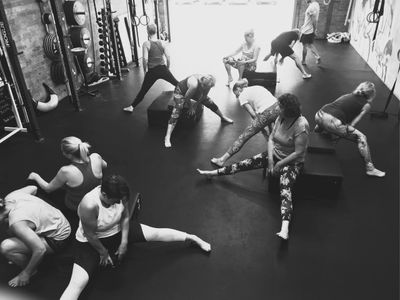
Most people treat the warm up as overhead. Something to get through before the real work starts. If class begins at six and you walked in at ten past, the temptation is obvious — skip the prep, get into the session, catch up.
It's the wrong trade. The warm up before a workout isn't filler at the front of the session. It's part of how the session works. Cutting it out doesn't save you ten minutes; it changes what the next forty are doing to your body, and not in a way you'll notice until something goes wrong.
What a warm up actually does to the body
Cold muscle, cold connective tissue, and a cardiovascular system still in resting state are not what you want to demand work from. A proper warm up raises body temperature, increases blood flow to the working tissues, lubricates the joints, and progressively recruits the nervous system. None of that is metaphorical. It's measurable, and it changes how the body responds to load — whether that load is external, your own bodyweight in an unfamiliar position, or the coordination demand of a complex movement pattern.
The mechanisms are well-established in the sport science literature. McGowan and colleagues, in a 2015 review in Sports Medicine, describe the effects across four categories — temperature, metabolic, neural, and psychological. Body temperature rises and muscle becomes more compliant. Oxygen uptake kinetics shift, so the cardiovascular system reaches its working state faster. The nervous system primes via post-activation potentiation, meaning the same muscle fibres respond more powerfully to a contraction once they've already been working. None of this is exotic — it's why athletes warm up, and why the same logic applies whether you're competing, working through a calisthenics progression, or practising a movement pattern that asks something specific of your shoulders and spine.
Skipping the warm up doesn't mean you can't train. It means you're training with a body that hasn't been told what's coming. Sometimes you get away with it. Sometimes you don't, and the thing that lets go is a wrist in a load-bearing position, a hamstring at end range, or a shoulder you've been managing for years.
Warm up and injury risk
This isn't a hedge — well-prepared tissue handles demand better than unprepared tissue. Range of motion improves with warm up. Coordination improves. Reaction time improves. The combined effect is that you move with more control through the patterns you're about to ask your body to express, which is most of what injury prevention actually is on a session-by-session basis.
The other half is mental. A warm up gives you four or five minutes to arrive — to stop being someone who was answering emails twenty minutes ago and start being someone who's about to invert their body, hang from a bar, or move in patterns the rest of the day didn't ask for. That shift matters. Most of the movements that go badly in a coaching environment go badly because the trainee wasn't in the room yet — head somewhere else, eyes off the work, breathing still set to office-chair pace. The warm up isn't only physical preparation. It's the bridge between the rest of your day and the work you're about to do.
What good warm up exercises look like
There's no single template, but the structure most coaches converge on has four components, in order.
Raise the temperature. Light, dynamic movement to get the heart rate up and blood flowing. This can be a few minutes of locomotion drills along the floor — bear, crab, or other ground-based patterns — a few rounds on a rower or bike, or movement-based games depending on the class, the day, and what's coming next. The point is to raise core temperature and signal to the body that work is starting.
Mobilise. Dynamic work through the joints you're about to use. Spine, shoulders, wrists, hips, ankles — the mix shifts depending on the session. A class with a lot of hand-loading needs careful wrist and shoulder prep. A class with floor work and locomotion needs spine and hip mobility. Dynamic stretching belongs here; static stretching belongs in the cool down. The distinction matters because long static holds before training reduce the very neural drive the warm up is meant to prime.
Activate. Specific muscle groups for what's coming next. Scapular work and band pull-aparts before pulling or pressing under load. Glute and hamstring activation before single-leg work or squat patterns. Anti-extension and anti-rotation work — dead bugs, bird dogs — for sessions that load the spine or ask the trunk to stabilise against asymmetric demand. These are short, deliberate, and intentional. Not filler reps to get through, but small precision movements that wake up the stabilisers before the working sets ask them to perform.
Practise the pattern. Lighter, simpler versions of the work in the session. If the session has handstand work, you spend time at the wall in easier positions before going to free balance. If it has a heavier loaded movement, you ramp up — bodyweight first, then light load, then closer to working weight. If it has a complex locomotion pattern or skill, you rehearse it slowly before the speed or intensity goes up. This is where coordination, technique, and load tolerance actually meet. The body has been raised, mobilised, and activated; now it gets to rehearse the specific pattern under reduced demand before that pattern matters.
If your warm up doesn't connect to the session that follows, it isn't a warm up — it's a separate light workout. The warm up earns its place by preparing you for the specific work coming next.
A note on games
Games aren't only a warm up tool. They might be — but often in our programming they're part of the work itself. Coordination and reaction games train the brain alongside the body, which matters more as you age and matters at any age if you want to stay sharp under physical demand. Games can be used as a reset between two hard blocks of work, when the body needs a few minutes of effort that isn't more of the same. They can shift the mood in the room — bring the energy back up after a stretch of difficult mobility or skill work, or bring laughter into a session that's been heads-down for too long.
The point is that a game in a class isn't decoration. It's doing a job. The job changes — sometimes it's neural, sometimes it's recovery, sometimes it's emotional — but the choice to use one is deliberate. Whether a game lives in the warm up, mid-session, or at the end depends entirely on what the session needs at that moment.
How long should a warm up actually take?
The honest answer is: long enough to do its job, no longer. For most strength and movement sessions in our space, that's eight to twelve minutes — sometimes a bit more if the day involves complex skill work or heavier loading, sometimes a bit less if the session is light. Less than five minutes and you're rushing the temperature rise. More than fifteen and you're using up the energy you're meant to be saving for the working sets.
If you're new to training, err on the longer end. If you're experienced and the session is moderate, the warm up can be tighter and more focused. The variable that should never compress is the practise-the-pattern stage — the wall handstand reps, the lighter locomotion rehearsal, the bodyweight ramps before load. That part is non-negotiable, regardless of how short the warm up needs to be.
The mistakes worth avoiding
Two are common enough to call out.
The first is treating the warm up as a stretching session. Static stretching held for thirty or sixty seconds isn't preparation — it has its place after the session, but the place isn't here. Dynamic stretching does the preparation work better, and dynamic is the operative word: movement through range, not stillness in range.
The second is making the warm up generic — the same five minutes regardless of what the session is. A warm up for a hand-balancing and shoulder-heavy session looks different from a warm up for ground-based locomotion, which looks different again from a warm up for a loaded lower-body session. If your warm up is identical every session, it's drifting away from its job. The warm up should sharpen as the session gets more specific, not stay the same shape regardless of what's coming.
How this fits the longer view
We program at Infuse Health for people who want to keep training for a long time. That intention shows up in obvious places — load progression, skill development, recovery, programming arcs across a block. It also shows up in less obvious ones, and the warm up is one of them. The few minutes you give it at the start of every session is not wasted time. It's one of the small structural choices that decides whether your training is still serving you in five years, or whether something has quietly broken in the meantime.
If you train with us in Movement & Strength or any other class, the warm up is built in. If you train somewhere else, build one of your own. Either way, don't skip it. The session you're preparing for is worth the preparation.
Infuse Health is a boutique movement and wellness studio at 4/10 William Street, Adamstown. You can start with a 4-week intro, a personal training session, or a single class — whatever fits what you're working with. Bookings through infusehealth.au.