"My body doesn't move like that" — and other lies
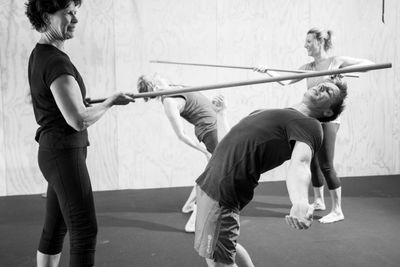
It's the most common sentence I hear from new members in their first week of training. Usually said quietly, usually with a small laugh, usually after the coach has demonstrated something that looked simple — a deep squat, a thoracic rotation, a shoulder reach overhead — and the member has tried it and found out their body, today, doesn't do that.
The sentence is almost always wrong. Not because the member is being self-deprecating, but because of what the word "doesn't" is doing. It's smuggling in a verdict. The body did the thing it could do today, in this position, with the warm-up it had, in front of a stranger. That's all the information the attempt produced. The leap from there to "my body doesn't move like that" is a leap from observation to identity, and it's the leap that quietly determines whether the next four weeks of training go anywhere.
What a first attempt at mobility actually shows
A first attempt at an unfamiliar position is not a test of capacity. It's a test of the position against the body's current movement vocabulary.
If you've spent twenty years sitting at a desk, the first time you try to get into a deep squat with your heels down and your chest up, your body is being asked to coordinate a pattern it hasn't been asked to coordinate in a long time. The ankles, hips, and thoracic spine all need to do something specific and synchronised. Most adults who try this for the first time can't do it cleanly. That's not a finding about their body. It's a finding about the gap between where they currently move and where the position lives.
The gap is the thing we work on. It's not closed by belief or willpower or wanting it badly enough. It's closed by repeated, specific exposure — usually in regressions first, then in the full position — across enough weeks that the relevant tissues, joints, and motor patterns adapt. Three to six weeks for the early changes. Months for the deeper ones.
Why new members apologise — and why the apology is the problem
There's a second thing that almost always follows the first attempt: an apology.
"Sorry."
"I'm so stiff."
"I haven't done this in years."
The apology is the tell. It says: I read my failed attempt as evidence about me, and I'm pre-empting your judgement by naming it first. The coach's job in that moment is not to reassure. Reassurance treats the apology as reasonable and quietly confirms that there was something to apologise for. The job is to reframe the attempt as data — to point out what the body actually did, what it didn't do, and which of those things is the thing we'll work on next.
Did the heels lift in the squat? That's an ankle restriction we can address directly. Did the chest fold forward? That's a thoracic and hip issue, and there are specific drills for it. Did the breath go shallow at the bottom? That's where we start the next set. None of this is available if the attempt doesn't happen, and none of it is available if the attempt is treated as a verdict instead of a rep.
Why the framing matters more than the body
A new member who treats early attempts as identity-level evidence — "this isn't for me," "my body is too far gone," "I should have started years ago" — usually doesn't make it past the first month. Not because the attempts were too hard. Because the framing made each attempt a referendum on whether they belonged in the room.
A new member who treats early attempts as information — "okay, that's where I am today" — keeps showing up. And four weeks later, the squat that wasn't possible is possible. The chin-up that was a hang is a pull. The thoracic rotation that felt locked has ten more degrees in it.
The difference between these two members is not their body. It's almost never their body. It's what they did with the first failed attempt.
The mindset piece, in plain language
Most writing about mindset in fitness is pitched at the wrong layer. It treats the work as something you do in advance — a belief system to adopt, a mantra to repeat, a reframe to perform on yourself before each attempt. Some of that is real. None of it is what's actually working in the moment we're talking about.
Mantras, reframes, and the longer work of building a training identity are real tools. Repeated language shapes identity, identity shapes habit, and habit shapes what you actually do on a Tuesday morning when motivation is thin. None of that is in dispute. But it's the wrong layer for the moment after a failed rep. The rep is already done. There's no mantra to deploy retrospectively.
What matters in that specific moment is much smaller and more concrete: whether you stay curious about what the rep showed or close down around what it meant about you. Whether you let the coach look at what your body did, name the gap, and prescribe the next thing. Whether you come back on Tuesday and try again, knowing the second attempt will be slightly different from the first.
That's the part that can't be done in advance. The longer work — the identity, the habit, the showing up — is real and necessary, and it brings you to the room. But the shift this piece is about happens in the room, after the failed rep, when you let yourself find out what the rep actually showed.
What to expect in your first sessions
If you're new to the studio, expect early sessions to contain attempts your body doesn't complete cleanly. Expect ranges you can't access. Expect positions that look easy when the coach does them and don't feel easy when you try.
None of that is a sign you're in the wrong place. It's a sign the session is calibrated correctly. Let the coach see the rep. Ask what they saw. Come back on Tuesday and do it all again.
Infuse Health is a boutique movement and wellness studio at 4/10 William Street, Adamstown. You can start with a 4-week intro, a personal training session, or a single class — whatever fits what you're working with. Bookings through infusehealth.au.