The Core You Had Is Not the Core You Have
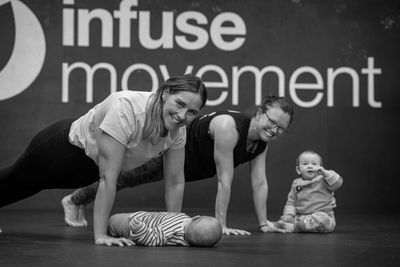
There is a moment, somewhere between three months and a year postpartum, when a woman tries to do something she used to do — pick up the toddler with the baby still on her hip, run for the bus, jump on the trampoline — and her body answers in a language she does not recognise. Something leaks. Something domes. Something feels hollow where it used to feel held. The first time it happens, most women assume it is a passing thing. The second or third time, they begin to suspect it isn't.
This is the part of the postnatal story that doesn't get the airtime it should. The pregnancy is documented. The birth is documented. The first weeks are documented in exhausting detail. And then, somewhere around the six-week check, the medical system politely lets you go, and you are left with a body that has been through one of the most significant physiological events of your life and very little guidance on how to train it.
The Movement for Mummas classes at Infuse Health exists for that gap — postnatal classes in Newcastle built around what the pelvic floor and core actually need after pregnancy. This is a piece about why the classes exists, what's happening physiologically, and what training for it should look like.
What pregnancy actually does to the postnatal core and pelvic floor
A full-term pregnancy stretches the abdominal wall substantially and loads the pelvic floor with the weight of a baby, a placenta, and several litres of additional fluid for the better part of a year. These are not injuries. They are normal physiological adaptations. But they are adaptations, and they don't reverse on their own timeline simply because the baby has been born.
Three changes matter most for training.
The linea alba — the connective tissue that runs down the centre of the abdomen — thins and widens. In late pregnancy, almost all women have some degree of separation between the rectus abdominis muscles (Mota et al., 2015). This is called diastasis recti, and it is universal in the third trimester rather than a sign that something has gone wrong. What varies is how the tissue recovers afterwards, and how well the deeper layers of the core learn to manage pressure across that midline once the baby is born.
The pelvic floor — the layered hammock of muscle and fascia at the base of the pelvis — is loaded under tension for months and then, in vaginal birth, stretched substantially in a short window. Caesarean birth changes the picture but does not exempt the pelvic floor from forty weeks of progressive load. Either way, the muscles need to relearn the timing of contraction and release, and the connective tissue takes longer than the muscles do.
The whole pressure-management system shifts. In a well-functioning core, the diaphragm at the top, the deep abdominals at the front and sides, the pelvic floor at the bottom, and the deep spinal stabilisers at the back work together to manage the pressure inside the abdomen. Pregnancy disrupts the geometry. Postnatal recovery is, at the deepest level, the process of these four surfaces re-learning to work as a coordinated system.
If the system doesn't relearn — and it often doesn't relearn on its own — pressure escapes through the path of least resistance. That path might be the pelvic floor (leaking when you sneeze, jump, run). It might be the linea alba (doming or coning when you sit up, lift, or hold a plank). It might be the lower back (dull ache that won't shift). The symptom looks like a local problem but it is usually a system problem.
Why traditional ab work is the wrong tool
The instinct, when the middle feels weak, is to train the middle harder. Crunches. Sit-ups. Planks. The instinct is reasonable. The application is often counterproductive in the early postnatal months.
Movements that produce high intra-abdominal pressure across an under-recovered linea alba can drive the doming pattern they're meant to fix. Movements that load the pelvic floor before it has restored its base contraction-and-release coordination can entrench the leaking they're meant to resolve. This is not a moral judgement on traditional core work — those exercises have their place once the foundation is back. It is a sequencing problem. You cannot load a system that hasn't yet relearned how to manage what it's already carrying.
What postnatal core training requires, in the first phase, is not more force. It is the restoration of timing. The diaphragm needs to descend on the inhale; the pelvic floor needs to lengthen with it; the deep abdominals need to recruit on the exhale; the pelvic floor needs to lift in coordination. None of that is loud work. All of it is foundational.
What the Movement for Mummas classes actually do
Movement for Mummas classes run five mornings a week, each 45 minute session drawing on a different discipline from the studio's timetable — Movement & Strength, Yoga, Pilates, and Endurance & Conditioning. Activity is programmed for bodies in the postnatal window rather than adapted on the spot. Load, range, and intensity are scaled to where recovery actually is, not to a generic fitness level.
Across the week, the sessions work different systems on the same recovery. Movement & Strength rebuilds full-body and grip strength and the capacity to carry, lift, and get up off the floor under load. Pilates rebuilds deep core and pelvic-floor strength and the postural control that a pregnancy and months of feeding tend to erode. Flow Yoga restores breath, thoracic mobility, and the range that carrying a baby quietly takes away. Endurance & Conditioning brings aerobic capacity back at a pace that meets a broken night's sleep where it is. Four mechanisms, one recovery, progressed at the speed your body sets.
During each class, the structure is the same for everyone in the room. What changes from one mum to the next is how the coach or teacher scales the movements and where she points your attention. For example, a woman six weeks past her clearance might be cued into a slower exhale on every chest press, or a smaller range in a Warrior 1 lunge, with the same shape held by the woman next to her at twice the load or full lunge depth. Both are benefiting from what the exercise or posture is built to give. The work does not need to look the same between two bodies for it to be the same work.
Our Mummas classes are taught by trained post natal movement, Pilates and yoga teachers, who are mums themselves. The room is small enough that they can see what's happening at the midline when you exhale on a press, whether you're holding your breath on the way up out of a squat, or whether your ribs are flaring when they should be stacking in a yoga asana. Those external signs are the proxies a good postnatal teacher or coach reads, because they're how pressure management in the pelvic floor shows up on the outside. Catching them is the difference between a postnatal class that works and a postnatal class that just looks like one.
Babies and toddlers come to every session. There's room to park prams, and space on the floor for little ones to play — there's a small selection of toys at the studio, and you're welcome to bring whatever keeps yours happy. Feeding and nappy changes happen in the gym itself; it's a room full of mums, so it's perfectly normal and nobody thinks twice.
If your baby needs feeding halfway through, feed them. If they need carrying, carry them — a good portion of the class works fine with a baby on your hip, and your teacher or coach will show you how. If you need to step out and come back in, step out and come back in.
What this is not
This is not a clearance to skip seeing a pelvic health physiotherapist. If you are in early postnatal recovery — dealing with leakage, prolapse symptoms, persistent pain, a significant diastasis, scar pain from caesarean or perineal tearing, or any symptom that worries you — a pelvic health physio is the right first call. If you don't already have someone, Female Focus Physiotherapy in Newcastle is who we'd point you towards — they specialise in women's pelvic health. Their assessment and ours sit on different parts of the recovery: theirs diagnostic and hands-on, ours strength-based and applied. The class does not replace the work a physio does, and where a physio has set you a program, we'll work with that rather than around it.
This is also not a class that demands you be a year postpartum, or six weeks postpartum, or any particular distance from birth. It demands that you have your six-week check with clearance from a GP or physio . After that, the program meets you where you are.
A practical note on what to expect
Movement for Mummas runs at the studio in Adamstown from Monday to Friday mornings at 9:45am. If you have just had a baby — first, second, third, fifth — and the body that's come out the other side does not feel like the body you went in with, that is not a failure of effort and it is not something you have to figure out alone. There is a way back, and it is more specific and more sequential than the internet tends to suggest.
If you'd like to come and see what the classes are like the simplest way in is our Mumma's 2-week trial priced at $49. Two weeks of Movement for Mummas — five mornings a week, babies and toddlers alongside you. No obligation after it ends. You can also call the studio if you'd rather have a short conversation about where you're at first; either way, the program will be set from there.
Infuse Health is a boutique movement and wellness studio at 4/10 William Street, Adamstown. You can start with a 4-week intro, a personal training session, or a single class — whatever fits what you're working with. Bookings through infusehealth.au.