Core stability: the foundation of strength and mobility
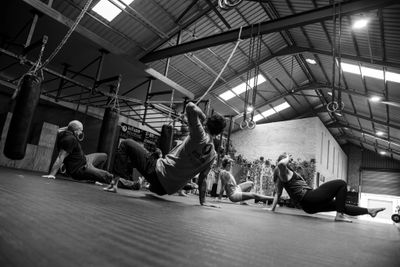
Most people picture a six-pack when they hear "core" — the visible muscles on the front of the torso. Core stability is a different thing, and a more useful one. It's the trunk control you have while everything else moves. Lifting a child off the floor, getting up from a low chair, catching yourself on uneven ground: all of it depends on core stability exercises and the underlying control they build, more than it depends on visible abs.
What core stability actually is
Core stability is the strength and control of the muscles that support your spine and pelvis while you move. That includes the abdominals, but it also includes the deeper trunk muscles, the lower back, the glutes, and parts of the hips and shoulders. The job of these muscles is not primarily to flex your spine — it's to keep your spine and pelvis stable while your arms and legs do work. Much of the modern framing comes from the work of Stuart McGill, whose research on spinal stability shaped how serious strength coaches think about this.
The useful way to think about it: your core is what allows the rest of your body to generate force without losing control of the position you're in. Lift a heavy load with no trunk control and your spine moves when it shouldn't. Reach overhead with no scapular control and your shoulder takes load it can't manage. Core stability is the part of the system that holds the line.
Why it matters
Injury risk. A trunk that holds position under load distributes force more evenly across the joints involved. That isn't a guarantee against injury — the research on core training and injury prevention is genuinely mixed — but better trunk control reduces the kind of compensations that load tissue unhelpfully over time.
Force transfer. Strong arms and legs can only do so much if the trunk between them is leaking position. A stable core is what lets a deadlift be a deadlift instead of a lower-back movement, and what lets an overhead press load the shoulder rather than the lumbar spine.
Movement quality. Stability isn't stiffness. A trunk that can hold position under load can also rotate, hinge, and bend through full range without losing that position. The two qualities work together, not against each other.
Posture and back. The popular claim that a weak core causes back pain has been overstated. Eyal Lederman made this case directly in a 2010 paper titled The myth of core stability, arguing that the rehab industry had built too much on too narrow a foundation — particularly the idea that weak deep abdominals are a primary cause of back pain. He's worth taking seriously. The honest version of the claim is narrower: trunk control is one input among several, and people who can hold their spine in a neutral position under load tend to feel better in their backs over time. That's worth training. It's not a cure-all. If your back is the specific thing you're trying to address, read more for a fuller treatment.
Core stability vs core strength
Core strength is the ability of those muscles to contract forcefully — how much load they can produce. Core stability is the ability to maintain position while producing force, or while resisting it. You can have one without the other. A heavy sit-up tells you nothing about how well your trunk holds position when someone shoves you sideways.
For most people training for general physical capability, stability is the more useful target. Strength follows, but the order matters.
Three core stability exercises we use at the studio
Useful core training looks less like crunches and more like resisting movement that's trying to happen. These three are in regular rotation in our Movement & Strength and Longevity classes.
Suitcase carry. Hold a kettlebell or dumbbell in one hand at your side. Set your shoulders, brace your trunk, and walk. The job is to not let your torso tilt toward the load. The obliques and lateral trunk stabilisers have to work to keep you upright. Start light. The point isn't how heavy — it's how clean the carry is. Distance over load.
Kettlebell windmill. Hold a kettlebell overhead in one hand. Hinge sideways at the hips, sliding the free hand down the inside of the opposite leg, eyes on the bell. Stand back up under control. This is a mobility-and-stability hybrid — it asks the shoulder to stay packed while the trunk moves through a deep side bend. Start with no load and add weight slowly.
Cat crawl. On hands and knees, lift your knees an inch off the floor and crawl forward by moving opposite hand and opposite knee together. Keep your hips low, your back flat, and a dowel or foam roller balanced across your lower back if you want a sharper feedback signal — drop the hips and the dowel rolls off. The trunk has to resist rotation and extension on every step. It looks easy and isn't. Start with short distances and build.
If you're training at home without equipment, hollow body holds, side planks, leg raises, bird dogs and superman holds cover most of the same territory. The principle is the same: hold a position your trunk doesn't want to hold, and resist the movement that wants to happen.
How to fit it in
Core stability work doesn't need a dedicated session. One or two of these exercises slotted into the warm-up or finisher of a regular workout, two or three times a week, is plenty for most people. The goal is consistency, not volume. Trunk control compounds slowly — a year of regular work shows up in how a deadlift feels, how a step out of the car feels, how a stumble on the footpath gets recovered.
Strong abs are a side effect. The thing worth training is the system underneath. If you'd like a hand programming this kind of work into your training, book a session with Manny.
Infuse Health is a boutique movement and wellness studio at 4/10 William Street, Adamstown. You can start with a 4-week intro, a personal training session, or a single class — whatever fits what you're working with. Bookings through infusehealth.au.