Balance Training for Adults Over 50 — How to Stop Falling
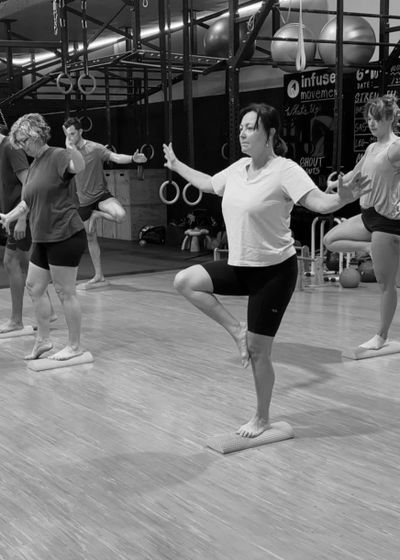
If you've been moving most of your life — walking, gardening, bushwalking, a regular yoga class, the occasional game of tennis — you'll usually notice the change in your balance before anyone else does. A slightly slower stand-up from a low chair. A hand on the wall in a dark hallway that wasn't there a few years ago. A less confident step coming down off a kerb when you're carrying something. Nothing dramatic. Just a quiet narrowing of margin.
Most people in their fifties and sixties don't reach for the words falls prevention until something forces them to. By then it's usually framed as a clinical problem. A short routine, often prescribed after a fall or a near-miss, designed to restore a baseline. Stand on one leg. Stand on a foam pad. Close your eyes. Repeat.
There's a place for that kind of routine. But on its own it's rarely enough, and it usually arrives too late. By the time you're in the protocol, the goal has shrunk to not falling again. The bigger goal — keeping the body capable enough that the question doesn't arise for another twenty or thirty years — needs different balance training.
What the evidence actually says
Third, the programmes with the strongest effects combine balance and functional training with resistance training, and reduce falls by around 34%. Balance and functional exercise on its own reduces falls by around 24%, aliwith stronger statistical certainty. Strength training on its own has uncertain effects in the literature. The reliable signal is balance-and-functional work — adding resistance training to it amplifies the effect. continued to rise as the population ages.
About one in three Australians over 65 has a fall each year, and roughly half of those who fall will fall again within twelve months. Behind the numbers is a quieter problem: fear of falling, after a first fall, makes people move less. Less movement accelerates the decline that made the first fall possible. The cycle is well-described and largely preventable.
What works is unambiguous in the literature. The 2019 Cochrane review established three findings that shape everything that follows.
First, exercise reduces the rate of falls by about 23% on average. That's the headline. It is also the floor.
Second, the effect size grows when balance is genuinely challenged — not just maintained — and when the dose exceeds about three hours a week. Programmes that meet both conditions reduce falls by closer to 39%.
Third, the programmes with the strongest effects combine balance and functional training with resistance training, and reduce falls by around 34%. Balance and functional exercise on its own reduces falls by around 24%, albeit this number comes with stronger statistical certainty. Strength training on its own has uncertain effects in the literature. The reasonable conclusion is that balance-and-functional work, and adding resistance training to it amplifies the effect.
The most studied of the standard physiotherapy-prescribed protocols — the Otago Exercise Programme, developed in New Zealand for frail adults — reduces falls in that high-risk population by around 35–40%. It does what it was designed to do. But a 2023 systematic review and meta-analysis by Yi and colleagues in Archives of Gerontology and Geriatrics found something else worth knowing. Across the trials, the programme improved balance, mobility, and lower-limb strength in frail and pre-frail older adults — but it showed no statistically significant effect on quality of life. It restored a floor. It didn't lift a ceiling.
That's the gap this piece is about. The work that actually changes how the next twenty years feel — not just how often you fall — looks different from a clinic exercise sheet.
Balance is a system, not a skill
The other reason short clinic protocols undershoot is that balance is not one capacity. It's at least four, working together.
There's the vestibular system in the inner ear, which tells you where your head is in space. There's proprioception — the body's internal map of where each joint is, drawn from receptors in muscles, tendons, and connective tissue. There's vision, which fills in gaps the other two can't. And there's muscular response time — how fast a hip, knee, or ankle can produce force when you've just stepped on something uneven and have about 200 milliseconds to do something useful with that information.
Each of these systems decays at different rates and for different reasons. Vestibular function declines with age but also with under-use — sitting still, looking at a screen, rarely turning the head sharply or moving in unusual planes. Proprioception declines when joints stop being loaded through full ranges. Reflexive muscular response declines fastest of all, particularly when training stops including any element of speed or surprise.
Standing on a foam pad for ninety seconds asks the proprioceptive system to work harder. It doesn't ask the vestibular system to do anything. It doesn't ask the hip or ankle to produce a sudden corrective force. It doesn't simulate the conditions under which actual falls happen. As a piece of a programme, it's useful. As the programme, it's narrow.
What balance training looks like when it's actually training
The work that holds up across the literature shares a few features. It loads the body. It moves the body in more than one plane. It includes elements of speed, response, and uneven surface. And it does so for long enough each week that the nervous system has reason to adapt. In practice, that looks like a few things layered together.
Loaded single-leg work. Step-ups, split squats, lunges, single-leg deadlifts — done with weight, progressed over weeks, coached for control. The hip and ankle that catch a stumble in real life are the same hip and ankle producing force in a Bulgarian split squat. The transfer is direct.
Reactive and perturbation work. A coach pressing gently on a shoulder while you stand single-leg. A medicine ball thrown back and forth from a tandem stance. A landmine press that asks the trunk to resist rotation while the legs hold position. These drills train the response time the foam pad cannot.
Movement through full ranges. Getting down to the floor and back up. Crawling. Loaded carries. Step-overs and step-throughs. The body's map of itself updates only when it's asked to navigate. Sitting still in a chair erodes that map; moving through varied positions rebuilds it.
Standing-leg endurance and ankle articulation. This is the quiet work. Holding tree pose for two minutes with the standing leg actually working, foot articulating, hip muscles engaged — that builds something a thirty-second balance test will never surface. Iyengar yoga in particular trains this: long held poses, attention to alignment, controlled work through the foot and ankle. It's the most patient end of balance training, and it complements louder strength work in ways that are easy to underestimate.
Vestibular and gaze training. Head turns under load. Walking while looking left and right. Cued direction changes. These are quietly some of the highest-leverage drills available, and they're often missing from programmes that focus only on standing balance.
Strength that holds up under fatigue. Most falls happen late in the day, when the legs are tired. A programme that only trains balance fresh — first thing in the session, on rested legs — is missing the condition under which balance most often fails.
This is how our Longevity classes are built. Functional strength, mobility, balance, and perturbation work — programmed for adults over 50, delivered at a sustainable pace, and coached so the load is right for the person on the day. Some of it looks unmistakably like training. Some of it looks like a game with a medicine ball that happens to be sharpening reaction time. Both are doing the same job. The Iyengar Yoga classes do the slower, more precise half — held standing poses, alignment under attention, the kind of foot and ankle work that strength training rarely reaches. The two are complementary rather than identical. Most members who come for one eventually do both.
Continuing the work at home
A class two or three times a week is where most of the work happens. But the systems described above respond to little daily inputs as well as bigger weekly ones. None of these need equipment. Most take a few minutes a day, and they meaningfully extend what you do at the studio.
Single-leg stance while you brush your teeth. Two minutes per leg, eyes open. When that gets easy, try it with eyes closed for short bursts — near a bench, in case you need it. The brushing isn't the point. The point is doing it daily without thinking of it as exercise.
Sit-and-rise reps. Five times a day, get to the floor and back up — and vary the path. Through a kneel one time, through a side-sit the next, through a squat the time after. The drill matters because of a 2014 study by Brito and colleagues, who found that lower scores on the sit-and-rise test in adults aged 51–80 predicted significantly higher all-cause mortality over six years. Whether the link is causal or just a marker of overall capacity, training the movement daily is one of the cheapest investments you can make.
Toe dexterity work. Pick socks up off the floor with your toes. Scrunch a tea towel under one foot. Pick up marbles or pencils with your toes and place them in a cup. The intrinsic foot muscles have a disproportionate say in balance because they're the bottom of the proprioceptive chain — and they tend to weaken in adults who spend most of their lives in supportive shoes. Two or three minutes a day rebuilds them quickly.
Ankle pogos. Small, low, springy bounces on the balls of the feet — knees soft, landing quiet. Twenty to thirty bounces, two or three times a day. This is the only at-home drill that trains the speed of force production, which is the capacity that decays fastest with age and is what catches you when you stumble. A caveat: pogos aren't right for everyone. If you have a history of ankle, knee or foot injury, plantar fasciitis, or significant osteoarthritis, skip this one or check with a coach or physio before starting. Build the prerequisite calf and ankle strength first.
Deep squat hold. Sink into a resting squat — heels down if you can, on a low cushion or rolled towel if your ankles won't yet allow it — and stay there for thirty to sixty seconds. Once a day. It's a position adults still rest in across most of the world but that most adults over 50 in Western countries have lost. Reclaiming it pays dividends in ankle mobility, hip range, and standing-leg recovery.
Tandem stance walking. Heel-to-toe, ten paces at a time. Old-fashioned, often dismissed, still useful. It trains a narrow base of support that real life occasionally requires.
These won't replace coached training, particularly if you've been away from movement for a while or you're managing a specific concern. But they keep the systems described above ticking over between sessions, and they start the work for someone who isn't quite ready to walk into a studio yet.
What this means in practice
If you're already moving regularly and you've noticed the kind of small narrowing this piece opened with, the work is to add what's missing rather than start over. For most experienced movers, what's missing is one or both of two things: progressively loaded single-leg strength work, or sustained attention to standing-leg quality. A reasonable week looks like one or two strength-based sessions and one yoga or mobility session, with the daily practice above filling the gaps.
If you've been away from training for a while — through injury, through illness, or simply because life got in the way of it — the first step is smaller, and that's fine. Walk into a class designed for adults in this stage of life, with coaches who'll meet you where you are and progress you from there. The capacities described above rebuild faster than most people expect, especially when the programming respects what your body is telling you on the day.
The thing to avoid, in either case, is treating balance as a tenth-of-a-session warm-up. The body that doesn't fall in its seventies and eighties is the body that's been asked, regularly and across years, to hold a single leg under load, recover from a stumble, get up off the floor, and produce force at speed when surprised.
That's not a clinic exercise. That's a way of training.
At Infuse Health our Longevity and Iyengar Yoga classes do most of this work between them. Longevity covers the strength, mobility, balance and reactive work. Iyengar Yoga adds the standing-leg quality and proprioceptive attention that strength training alone doesn't reach.
Infuse Health is a boutique movement and wellness studio at 4/10 William Street, Adamstown. You can start with a 4-week intro, a personal training session, or a single class — whatever fits what you're working with. Bookings through infusehealth.au.